




Heatwaves: How can we cool our cities?
With heatwaves becoming more frequent, longer, and more intense across Europe and other parts of the world, urban cooling has returned to the forefront of public debate. Once seen as a matter of comfort, providing relief from extreme heat is now a public health issue. As the world’s leading operator of district cooling networks, ENGIE has developed valuable expertise in improving the efficiency of cooling systems and reducing their environmental impact.
Insights from Alexis Goldberg, Chief Commercial Officer for Cooling Networks in France, and Romain Rousselet, Head of Urban District Cooling Markets for France.
We’re once again experiencing extreme heat events in the Northern Hemisphere. What’s your assessment of the situation?

Heatwaves are increasingly impacting quality of life, public health, and the economy (due to lower productivity). Dense urban areas are the most affected—especially hospitals, daycares, and public buildings. The risks are particularly high for vulnerable populations: infants, the elderly, those with chronic illnesses, outdoor workers, and others.
These extreme weather events call for rapid, coordinated responses tailored to local needs.
Romain Rousselet, Head of France for urban cooling network markets

Cooling cities has become a public health necessity. To be resilient, cities must adapt by all available means.
Among passive solutions, we have urban greening which creates cooling zones and biodiversity corridors, absorbs CO₂ through photosynthesis, and makes cities more livable. According to Cerema, a major French public agency for urban planning, greening a schoolyard can lower perceived temperatures by 2 to 4°C. Reflective roofs can reduce indoor temperatures by an average of 8°C.
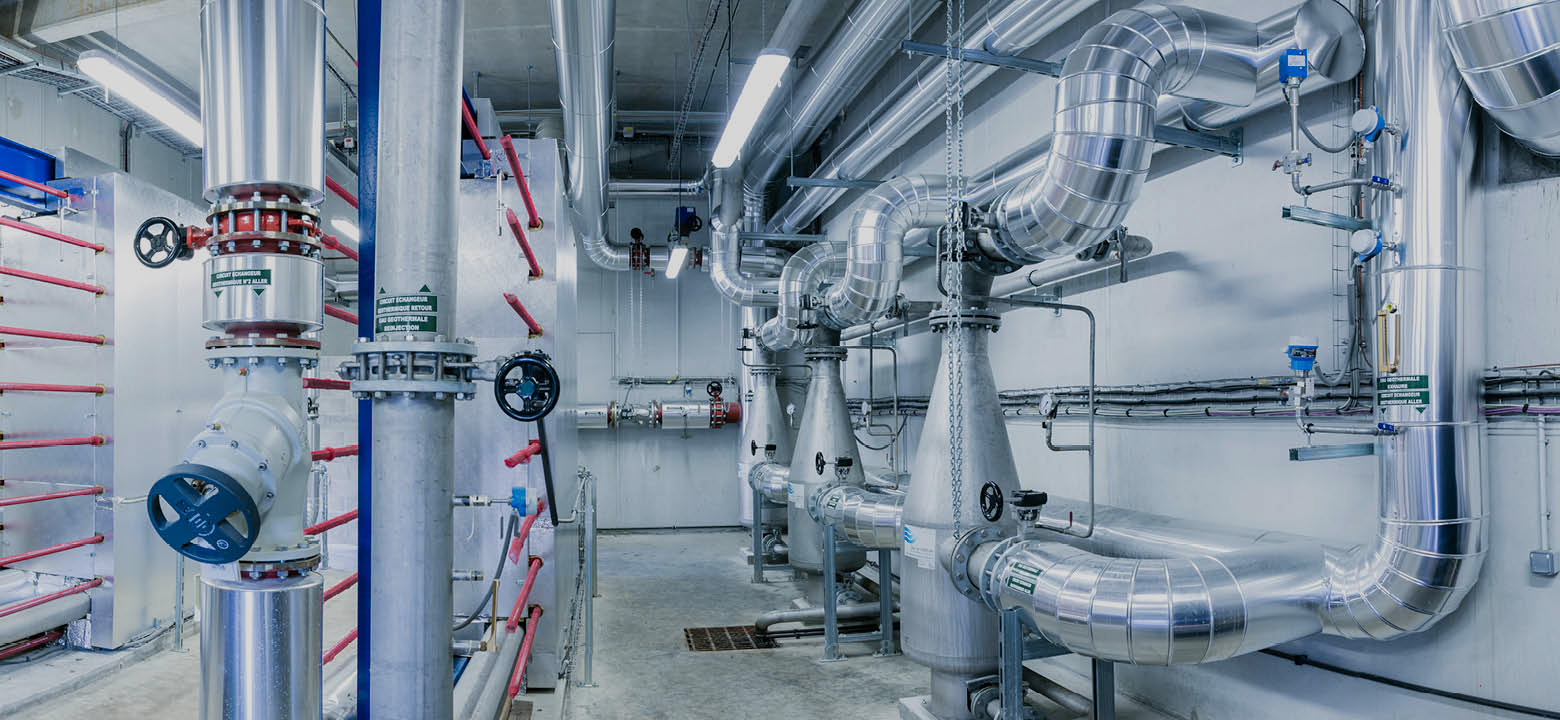
But passive measures alone aren’t enough. We also need active solutions—especially alternatives to individual air conditioning. This is where district cooling networks come in: centralized systems that produce cooling on a large scale and distribute it to buildings through chilled water pipelines.
Alexis Goldberg, Sales Director for France for cooling networks
Why are district cooling networks more sustainable than traditional A/C systems?
Romain Rousselet : “On average, district cooling consumes half the electricity, emits half the CO₂, and results in ten times fewer refrigerant leaks than individual air conditioners. The excess heat can also be safely discharged into natural environments like rivers without harming biodiversity.”
Alexis Goldberg : “In cities like Bangkok, each building has its own A/C unit. As a result, interiors get cooler… but exteriors get hotter. Hot air expelled by thousands of units turns the city into a pressure cooker, especially at night. The temperature difference between city and countryside can reach 5 to 8°C.
District cooling, by contrast, is a collective, energy-efficient, and intelligent solution. It centralizes production, uses less energy, and doesn’t discharge hot air into the streets.”
What role does ENGIE play in all this?
Alexis Goldberg : “We see ourselves as urban energy architects. We combine different solutions and help local authorities design and implement their sustainable energy infrastructure.”
Is this a major market?
Alexis Goldberg : “We’re at a turning point, shifting from a focus on thermal comfort to one of territorial resilience. Global demand for district cooling is expected to triple or even quadruple. Right now, there are only about 1,500 such networks worldwide—a tiny number compared to the market potential.
In France, for instance, out of 1,630 TWh of final energy consumption, 600 TWh (nearly 40%) go toward heating and cooling. Yet district cooling accounts for less than 1 TWh. There are about 1,000 district heating networks in France, but only 43 cooling networks.
There’s huge room for growth—especially since the share of renewables in these networks has risen from 33% to over 66% in the past ten years.
In many new urban developments across Asia and the Middle East, district cooling is now included from the very start of planning.”
“Global demand for district cooling networks is set to triple or quadruple” (Alexis Goldberg)
What are the most promising technologies?
Romain Rousselet : “New possibilities are opening with thermal storage, geothermal energy, and thalassothermal systems, which use water as a heat source. Real-world applications already exist: Paris uses water from the Seine, and Marseille powers its Thassalia plant with water from the Mediterranean. In Levallois, another approach is used: ice storage. Cooling is produced at night when demand is low and used during daytime peaks. This system is vital to ensure continuous service for sensitive sites like hospitals and data centers.
There’s no shortage of innovative ideas, but the full potential of these technologies is far from realized.”
Because the market is still maturing?
Romain Rousselet : “Yes. The market has only recently started to scale (about ten years ago), even if some networks are older. The Fraîcheur de Paris network was launched in 1991 to help preserve artworks at the Louvre. Stockholm’s dates from the same period.
In France, the number of networks has doubled over the past decade. The national energy strategy (PPE) projects a tripling of cooling demand by 2035—from 1 TWh in 2022 to 3 TWh.”
What about other regions of the world?
Alexis Goldberg : “Demand is massive in Southeast Asia and the Middle East, where extreme climate conditions overlap with high urban density. These regions also benefit from natural resources like geothermal energy.
ENGIE operates around 100 district cooling networks worldwide—most of them in the AMEA region (Africa, Middle East, Asia). Tabreed, in which ENGIE holds a 40% stake, is the market leader in its region.”
What obstacles still remain?
Alexis Goldberg : “District cooling still lacks visibility in Europe—less so in Asia or the Middle East.
We’re competing against well-established individual A/C systems, which are familiar to the public, with sales channels, maintenance services, and refrigerant supply chains. District cooling, by contrast, is largely invisible to end users.
Also, 95% of district cooling clients are commercial buildings. For the market to grow, technologies need to adapt to the residential sector, which is the next major growth frontier.”
Is artificial intelligence changing the equation?
Romain Rousselet : “Generative AI is driving demand for computing power—which increases the need for data centers, and thus for cooling. To handle this growing energy use, we must choose efficient, low-impact solutions. District cooling has a key role to play in this equation.”
Can we still be hopeful?
Alexis Goldberg : “The situation is extremely concerning. Global warming has already reached +1.7°C compared to pre-industrial levels, and we’ll likely hit +2°C by 2030. If nothing is done, we could reach +4°C by 2050. Paris could feel like Marseille—without the Mistral wind. Fortunately, the French capital continues to expand its Fraîcheur de Paris network, the largest in Europe.”
“It is now the responsibility of public authorities and industry to design the cities of tomorrow—with both thermal comfort and infrastructure resilience in mind. The good news is: the solutions already exist.”
ENGIE operates over 100 district cooling networks, including:
ENGIE’s most iconic cooling networks

In Barcelona, the Districlima heating and cooling network supplies more than 190 buildings over 25 km.
In Spain, ENGIE operates the country’s leading heating and cooling network.

In Abu Dhabi, Tabreed produces renewable cooling
The company, 40% owned by ENGIE, is betting on geothermal energy to cool urban areas, with a pioneering site now operational in Abu Dhabi.
Innovation

AlpinovX makes cold using water
As the Northern Hemisphere faces yet another heatwave, spotlight on this startup which is backed by ENGIE New Ventures. It harnesses the power of water to produce cooling.
Find out more
Find out more
-
Heating and cooling networks

What do you want to do?